River Rock Calculator for Indiana Beds, Borders and Creek Lines
Enter your project dimensions
The order that goes wrong on this page is nearly always the one sized on area alone. Somebody measures a border, orders what looks like enough stone, spreads it out and can still see fabric through it by the second week. Nothing was short. The layer was thin, because the depth has to follow the size of the stone, and big rock at a small depth leaves gaps. The river rock calculator turns a bed into cubic yards and tons once you have given it the right depth, so the worked example below starts with that decision rather than with the tape.
A Drip Line at the Machine Shed, Counted Out in Tons
Take a 55 ft run of bed along the drip line of an outbuilding, 3.5 ft out from the wall, filled with 1 to 3 in stone. That size wants around 3 in of depth to cover the ground properly.
- 55 x 3.5 = 192.5 sq ft
- 192.5 x 3 / 12 = 48.1 cubic feet
- 48.1 / 27 = 1.78 cubic yards
- 1.78 x 1.35 = 2.4 tons
- With the 5% box ticked: 1.87 cubic yards, 2.5 tons
That is a hypothetical layout, not a customer job, but the shape is common enough on a farmstead. Roof water comes off an unguttered steel roof in a line, and a stone strip takes the hammering that would otherwise cut a rut in the clay. Put non-woven fabric down first, pin it, then grade the finished stone slightly away from the wall so the water leaves rather than soaks in at the footing.
Feeding Four Splash Zones and a Curved Border to the River Rock Calculator
- Pick rectangle, circle or multiple areas. Multiple areas takes five pieces and adds them, which is how four downspout splash zones and a front border go in as one job.
- Length and width in feet. A round bed or a tree ring goes in as a diameter in feet.
- Depth in inches, anywhere from 0.25 to 24. Match it to the stone: 2 in for 3/4 to 1 in rock, 3 to 4 in for 1 to 3 in rock, 4 to 5 in for larger pieces.
- Choose the material so the weight is right.
- Tick the 5% box for spillage. Decorative rock is not compacted, so this is margin rather than settlement.
- Press calculate and read cubic yards, tons and cubic feet. Email my quote sends the figures over so the numbers survive the walk back to the house.
A curved bed is not a problem. Measure the length down the middle of the curve and use the average width across it. Beds that pinch and swell can be entered as two or three rectangles instead of one guess.
Lighter Than Crushed Gravel, and Smaller in the Heap
River rock is published on this site at about 2,700 lb per cubic yard, which the tool reads as 1.35 tons a yard. That is lighter than crushed gravel at roughly 2,800 lb and lighter again than graded base stone at 3,000. It is also the reason a delivered ton looks smaller than people expect, since a ton of it takes up only about three quarters of a cubic yard.
Coverage follows the size of the stone more than anything else. One ton of 3/4 to 1 in rock spread 2 in deep covers roughly 120 sq ft. The same ton of 1 to 3 in rock at 3 in covers about 80. Large 2 to 4 in stone laid 4 to 5 in deep covers near 53, and oversize accent pieces set as a single layer cover 35 to 50. Doubling the stone size halves the ground a ton covers, which is the whole arithmetic of this page in one line.
To check any of it by hand: square feet times depth in inches, divided by 12, gives cubic feet; divide by 27 for cubic yards; multiply by 1.35 for tons.
Ordering for the Edge Where a Bed Thins First
Rock beds do not run short in the middle. They run short along the front edge, where the stone gets kicked and raked and where it shows most, so the surplus is worth having.
- Order the rounded-up ton rather than the exact figure and put the extra along the visible edge.
- If fabric shows after spreading, the depth was light. Adding an inch across the bed is a smaller job than lifting stone and starting again.
- Keep leaves off with a low-speed blower rather than a rake, which flicks stone into the grass where a mower finds it.
- Rinse the bed once it is spread. Quarry dust dulls the color until it washes off.
- Strip old mulch out before rock goes over it. Mulch breaking down underneath leaves the surface uneven and gives weeds a seedbed between the stones.
Three Sizes on the List, and the One That Stays Put in a Creek Line
Three products cover most of what people plan here, and the difference is job first, looks second.
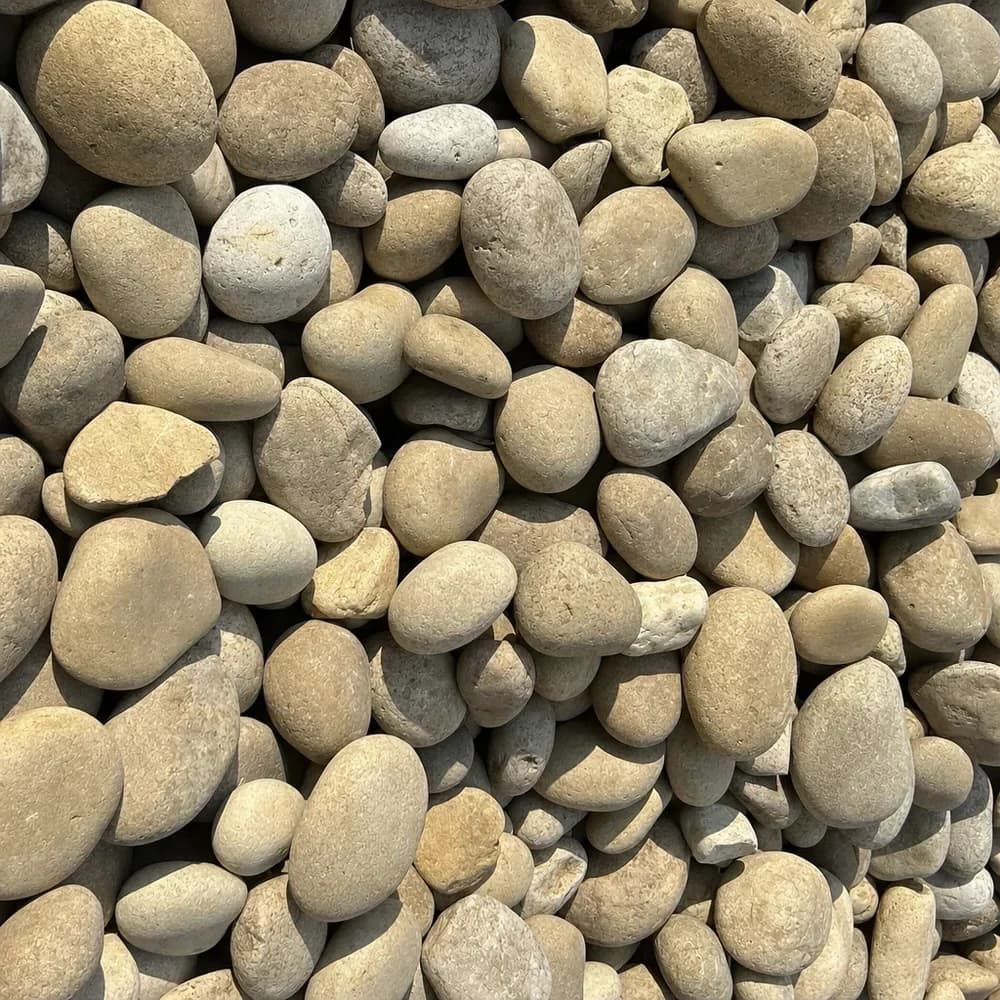
- River rock suits borders, splash zones, mow strips and the body of a decorative bed.
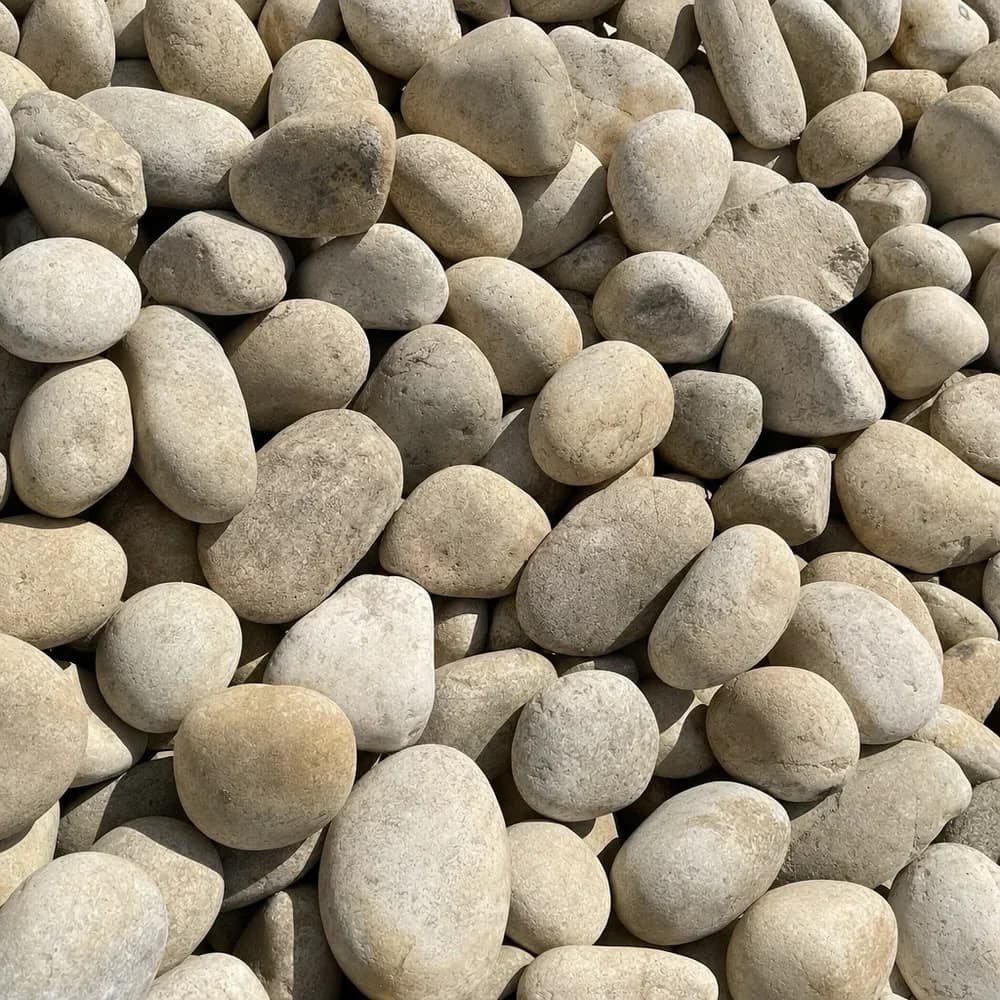
- Large river rock belongs in dry creek beds and heavier erosion work, where the stones have to stay put when water runs through. Set the biggest pieces about a third into the ground so they look placed by water rather than tipped out of a bucket.
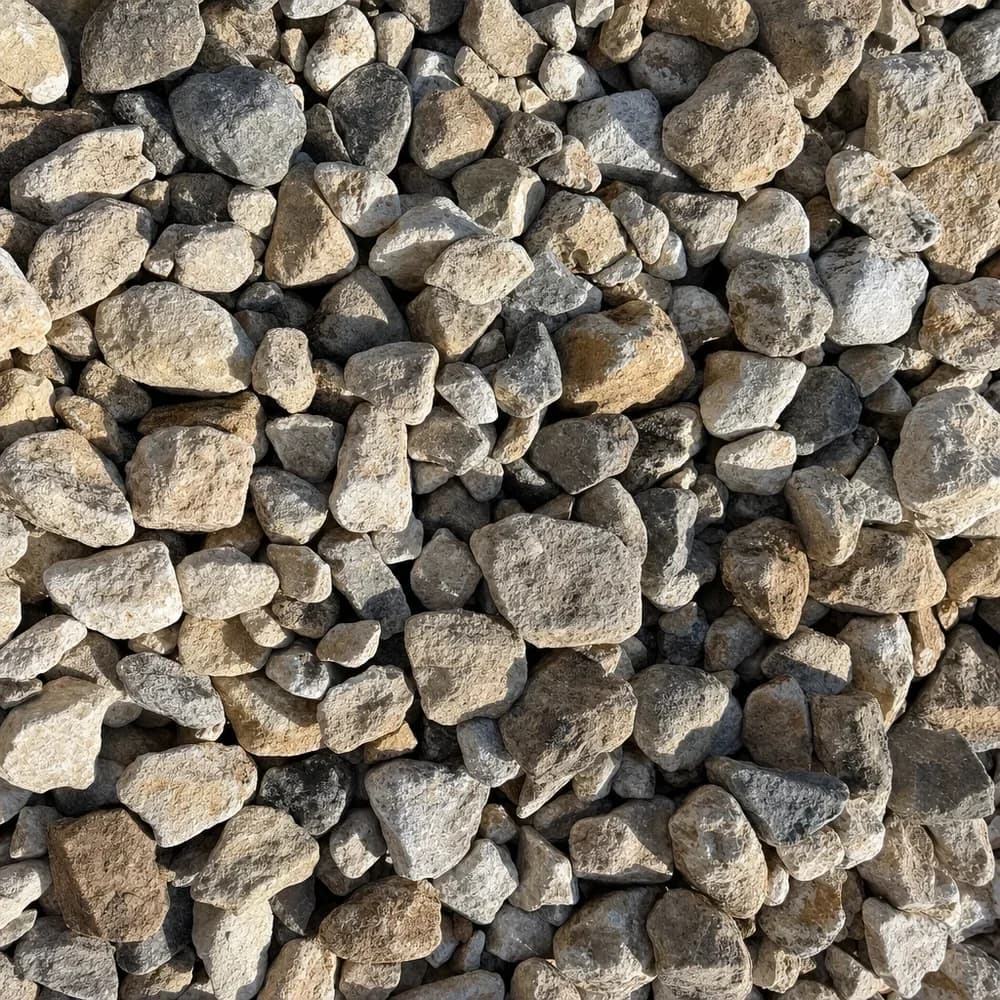
- Drain rock is the working choice for a French drain, a foundation drain or a downspout run on flat ground with nowhere to shed water. In an active drainage line, wrap the stone in fabric rather than laying fabric under it.
A dry creek line makes the sizes easy to feel. A 35 ft channel averaging 5 ft wide at 4 in works out at 175 sq ft, 58.3 cubic feet, 2.16 cubic yards and 2.9 tons, again as an example rather than a real project. Compare it against a bed of shredded mulch over the same ground and the trade is clear enough: mulch feeds the soil and has to be renewed, rock stays where you put it for years. For planted beds in a hot, humid Indiana summer, mulch usually treats the roots better; rock earns its place on borders, drainage lines and edges. Run the same dimensions through the mulch calculator if you want both figures side by side.
When the tonnage is settled, open the product page, set the quantity and choose a delivery date. Delivery is arranged at checkout by ZIP code, and the truck needs a firm spot to tip where a wheelbarrow can reach the bed.
Common questions
I have the tonnage. Which product page do I buy it on?
Whichever size the depth was based on. A figure worked out at 3 in of 1 to 3 in stone belongs on the River Rock page; a dry creek sized at 4 to 5 in belongs on Large River Rock; a drain sized at 12 in or more belongs on Drain Rock. Changing the size after calculating changes the depth it needs, so run it again rather than reusing the old number.
Where should the load be tipped for a bed at the back of the house?
On the drive or another firm surface as close to the bed as the truck can safely get, with clear room overhead for the box to lift. Rock spreads out as it lands, so allow more ground than the pile looks like it needs, and keep it off the bed itself so you are not moving the same stone twice.
The result shows yards and tons. Which figure is the order?
The ton figure. Rock is sold by weight here, and the cubic yards are there to tell you how much space the pile will take and to let you check the arithmetic.
Is the depth I enter the loose stone or the settled stone?
Loose, as spread. This rock is not compacted and barely settles, so what you enter is what you see. The 5% box covers spillage rather than any loss of depth.
A tree ring is going in round. What do I measure?
Use circle mode and take the diameter across the whole ring. A 7 ft ring at 3 in comes to about 38.5 sq ft, 9.6 cubic feet, 0.36 cubic yards and 0.48 tons. The trunk itself is too small to subtract, and keep stone off the bark rather than piled against it.
Related calculators
Rock beds are a one-time buy.
River rock, large river rock and drain rock by the ton, free delivery included.