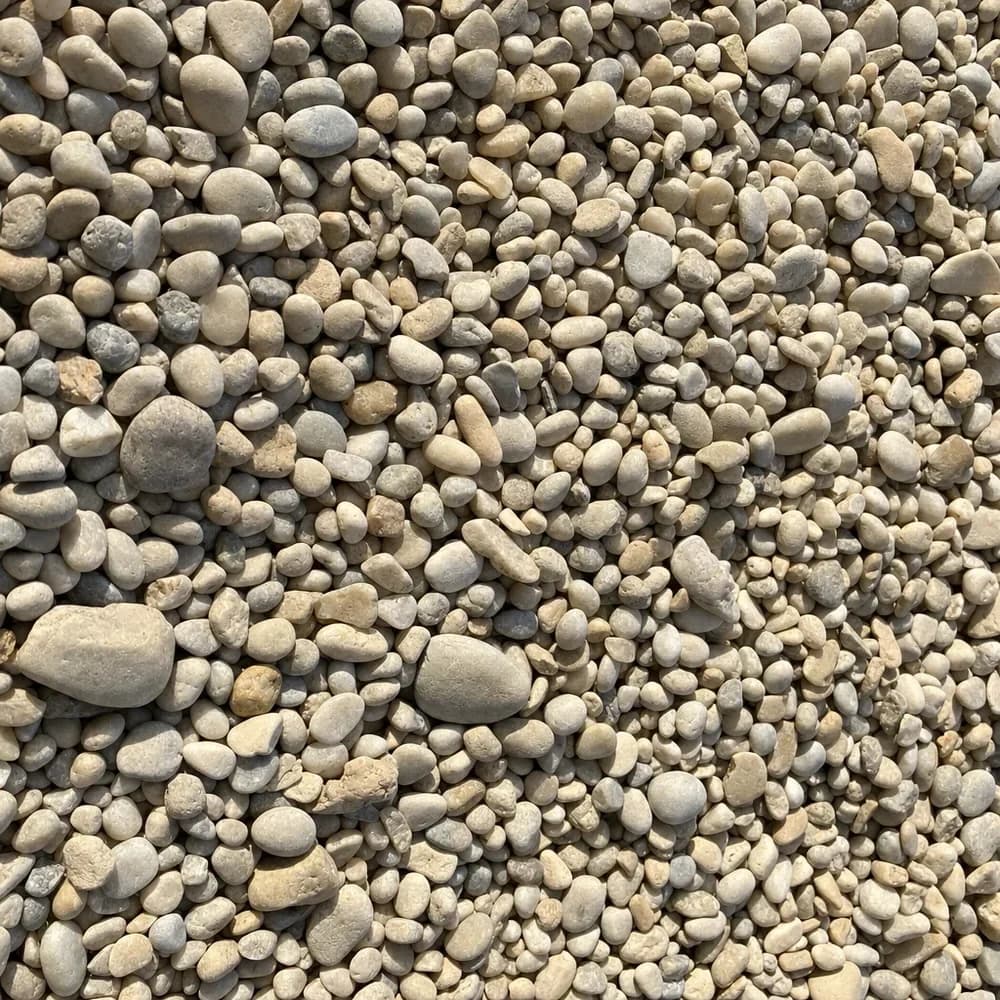
Pea Gravel Calculator for Indiana Paths, Pits and Play Areas
Enter your project dimensions
Rounded stone goes down best in the same stretch of the year that everything else here does: late spring, once clay has dried enough to grade and tamp, through to the first hard freeze. Lay it on ground that is still saturated and the stone presses straight into the mud, and by the second winter you are looking at gravel with clay coming up through it. Get the base right in the dry weeks and the surface will hold. This pea gravel calculator handles the quantity once the depth is settled.
Pea Gravel Depths for Paths, Fire Rings and Fall Zones
| The area | Depth to enter |
|---|---|
| Garden path or walkway | 2 to 3 in |
| Patio or seating area, over a compacted base | 2 to 3 in |
| Fire ring apron | 3 in |
| Dog run | 2 to 3 in |
| Playground fall zone under equipment | 9 to 12 in |
Depth on this material has a ceiling and a floor, which is what separates it from stone that carries load. Under 2 inches and the ground shows through in the traffic line within a season. Over 3 and walking on it feels like walking in dry sand, because round stones roll past one another instead of locking. The only exception is a fall zone, where the whole point is that the surface gives way, and the equipment manual sets that figure rather than this table. Note what the tonnage buys: landscape pea gravel, not certified playground surfacing. The required depth, the fall-zone footprint and the maintained depth all come from the equipment manufacturer's instructions rather than from us.
Getting a Fire Ring Apron In as a Circle, Minus the Pit Itself
- Choose rectangle, circle or multiple areas, which takes up to five pieces and totals them.
- Enter length and width in feet, or the diameter in feet for a round apron.
- Enter the depth in inches, anywhere from 0.25 to 24.
- Choose the material.
- Tick the 5% box for spillage. There is very little compaction in rounded stone, so this is covering the wheelbarrow rather than the layer.
- Read cubic yards, tons and cubic feet, and email yourself the result.
A fire ring apron is a circle with a hole in it. Size the full circle, then size the pit, and take one off the other. A 17 ft apron around a 5 ft ring is 227 sq ft less 19.6 sq ft, so about 207 sq ft of stone. At 3 in that is 51.8 cubic feet, 1.92 cubic yards, or 2.7 tons.
Tons for a Dog Run, a Seating Circle and a Swing Set Fall Zone
Sample layouts with sample dimensions, not customer projects.
The dog run. 16 ft by 10 ft is 160 sq ft, at 3 in:
- 160 x 3 / 12 = 40 cubic feet
- 40 / 27 = 1.48 cubic yards
- 1.48 x 1.40 = 2.1 tons
The seating circle. An 18 ft circle is 3.14 x 9 x 9 = 254 sq ft, at 3 in:
- 254 x 3 / 12 = 63.5 cubic feet
- 63.5 / 27 = 2.35 cubic yards
- 2.35 x 1.40 = 3.3 tons
The fall zone. 18 ft by 18 ft is 324 sq ft, at 12 in:
- 324 x 12 / 12 = 324 cubic feet
- 324 / 27 = 12.0 cubic yards
- 12.0 x 1.40 = 16.8 tons
Two small areas, two tons and three. One play area, nearly seventeen. Depth does that, and it is the reason the fall zone is a delivery to plan around while the other two are an afternoon.
Two Thousand Eight Hundred Pounds a Yard for Stone That Feels Light
| Material | Weight per cubic yard | Tons per yard |
|---|---|---|
| Pea gravel, 3/8 inch | approx 2,800 lb | 1.40 |
| Crushed walkway gravel | approx 2,800 lb | 1.40 |
| River rock, 1 to 3 inch | approx 2,700 lb | 1.35 |
Rounded stone packs with less empty space than most people expect, so it weighs the same per yard as the crushed material it is often compared against. At 1.40 tons a yard, one ton is about 0.71 cubic yards. Laid 2 inches deep a ton covers roughly 116 square feet, at 3 inches about 77, and at a 12 inch fall zone depth about 19.
Edging First, Then the Bucket Held Back for the Traffic Line
Rounded stone migrates. That is its one real fault and it is entirely fixable:
- Set steel, aluminum, timber or paver edging about an inch above the finished surface. Edging laid flush loses stone over the first season.
- On grades steeper than about 5%, rain and feet carry the gravel downhill regardless. Use a stabilizing grid under it, or switch to angular stone on that stretch.
- Under a seating area, put 2 inches of compacted limestone screenings below the gravel so chair legs stop sinking, or #8 stone where the ground needs to drain as well as carry.
- A bed meant to be looked at rather than walked on is usually larger stone, sized on the river rock calculator.
- Keep a bucket or two back. The line people actually walk thins out first, and refilling it every couple of springs is a five minute job if the stone is on hand.
Pea gravel or crushed, and which tool. Round stone is comfortable underfoot and looks settled around a fire ring, so it earns its place on flat, contained areas. Crushed walkway gravel has sharp edges that lock together, which is what you want on a slope or a busy route, and it is sized with the gravel calculator. Both sit on the same 1.40 figure, so a single footprint can be priced either way without re-measuring. A long path can use one material on the flat and the other on the grade.
Take the tonnage to the product page, set a quantity and choose a date there. Delivery is arranged at checkout by ZIP code, and the truck needs room to tip clear of the beds you are about to edge.
Common questions
The result gives yards and tons. Which one is this stone sold in?
By the ton, so that is the figure to carry over to the product page. Keep the cubic yard number for checking the job against the coverage figures above, since a yard at 3 inches covers 108 square feet and that is an easy number to picture.
Pea gravel barely compacts. What depth do I type in?
The finished depth you want to walk on, because there is no meaningful settlement to allow for. That is the difference between this material and a dense graded stone, where the number you enter and the number you dump are never the same.
The fire ring apron is a circle with a hole in the middle. What goes in the diameter box?
The outside diameter, run first. Then run the ring itself as a second circle and subtract. A 17 ft apron around a 5 ft ring leaves about 207 square feet of stone, and skipping the subtraction on a small job overshoots by about a tenth.
Is there a quick way to check the answer against the coverage table?
Divide your square feet by the coverage per ton at your depth. A 160 sq ft dog run at 3 inches, where a ton covers 77 sq ft, comes to about 2.1 tons, which is exactly what the arithmetic gives. Two routes to the same figure is the best check there is.
Why does river rock come back lighter than pea gravel over the same area?
The cubic yards are identical, because volume does not care about the stone. Weight is the variable, and this site publishes river rock at about 2,700 lb per yard against 2,800 for pea gravel, so the tonnage separates slightly while the yardage does not move at all.
Related calculators
Under two tons covers most patios.
3/8 inch natural pea gravel, priced by the ton, delivered free.