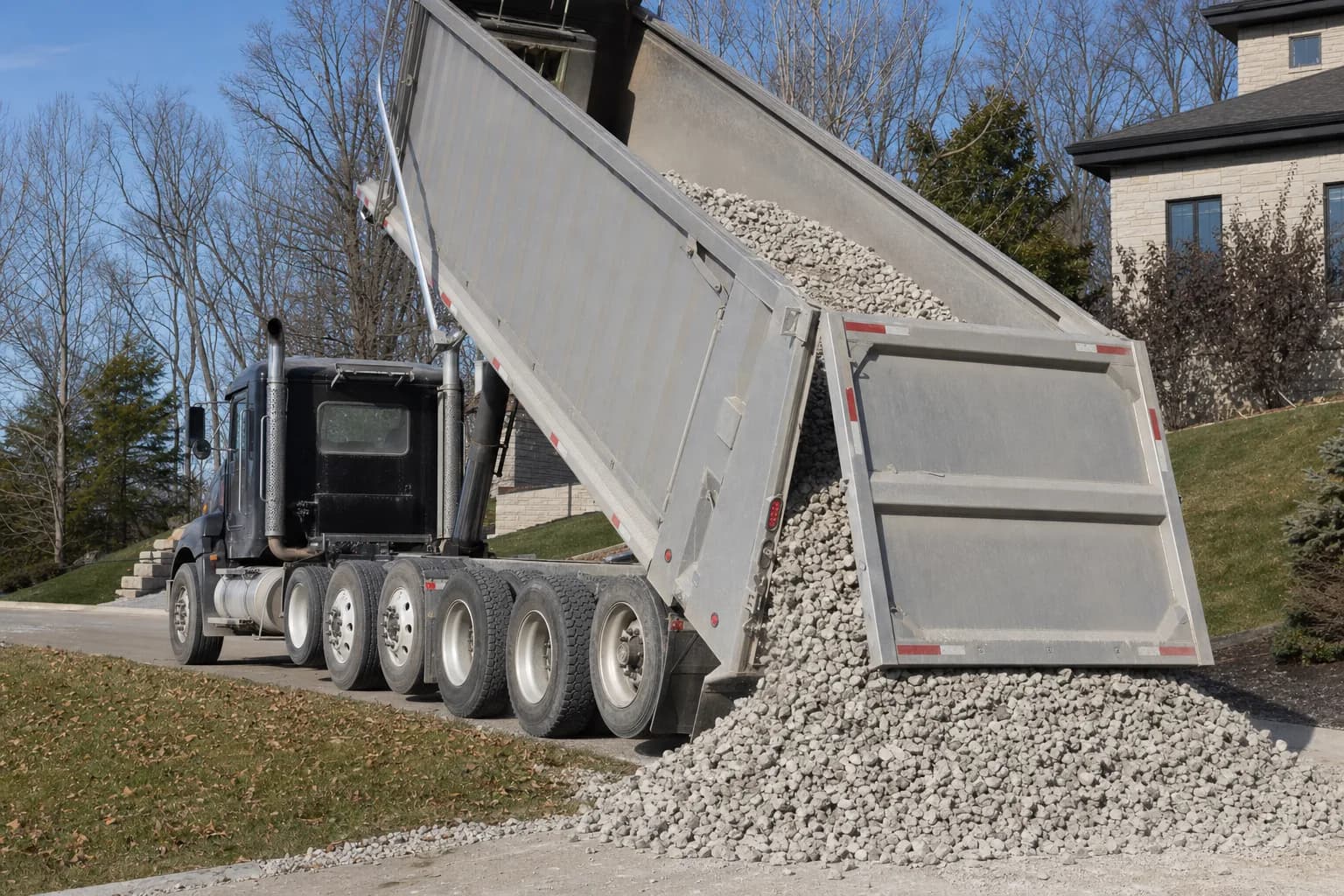
Bulk Material Delivery in Indiana: Season, Access and the Drop
The weather window decides more about a delivery here than anything on the order form. Between the late winter rain and the point in spring when the clay has finally given up its water, a loaded truck on a farm lane leaves ruts behind it, and stone dropped onto soft ground gets pushed into the subgrade rather than sitting on it.
Which Weeks of the Year Will This Ground Actually Take a Load?
For anything that has to compact, late spring through fall. Saturated till will not tie together under a roller no matter how many passes it gets, and frozen ground stops compaction outright through the winter months. In the northwest counties the low sand plains and the old ditched marsh ground hold water longest after snowmelt, so give those the extra weeks. The flat fragipan ground and river lowlands in the south and southwest stay wet through winter and spring for the same reason and dry later than the uplands beside them.
Bed work is far less fussy. Mulch, decorative rock and topsoil for a border can go down in any dry week, because nothing under them has to carry a load.
How Does the Site Know It Can Reach My Address?
By ZIP code, entered at checkout. The order is then matched to a supplier in the network near that address, and an agent contacts you to confirm the exact delivery address, so it is confirmed rather than guessed at. The confirmation names the date you chose and a local contact. Dates offered are weekdays, and there is a field for where the load should be dropped. Free delivery, where it applies, is the site's current delivery offer and is shown at checkout with the rest of the order. You can check an address by ZIP first, then pick the date, the quantity and the product.
What Does a Dump Truck Need to Get Down a Farm Lane?
Walk the approach the way a driver would, before the order rather than after it.
- A clear route of roughly 12 feet in width the whole way in, with no pinch points at a gate post or a corner of the barn.
- Nothing hanging over it. Low limbs and overhead wires stop a truck sooner than a soft shoulder does.
- Ground firm enough to hold the truck while the bed is raised, since a raised bed puts the whole load of #53 stone, or whatever else is on board, onto the back axles.
- Room to turn. Three hundred feet of blind backing down a lane between fence lines is where problems start.
If the approach is doubtful, pick a firmer drop point near the gate and move the material in with a tractor or skid steer. That beats a truck stuck halfway down the lane.
Where Should the Pile Land If the Yard Is Still Soft?
Mark it. A stake, a cone, a bucket turned upside down, anything visible from the cab. The usual spot is the drive or reachable ground beside it, and the material comes off as a single pile at that point.
On the till plain, choose the marker for what happens after the truck leaves as much as for the drop itself. Ground that ponds in March will not hold a wheelbarrow in April, so a pile on the drive that has to be carted 60 feet is often less work than a pile that sank where it landed. Keep it clear of a tile riser, a septic field and the turf you care about, and keep it off the line where water runs after a storm.
Do I Need to Be Standing There When It Arrives?
No. Leave the route open, the marker in place and a note in the drop instructions at checkout, and keep a phone nearby in case the driver wants to check the spot before tipping. The tip itself runs roughly 10 to 15 minutes, so there is not much of a window to catch even if you wanted to.
Does the Frost Depth Change When the Load Should Come?
Sometimes, though not where it goes. Footing depth is set by the building department covering your parcel and the figure moves across the state, with around 30 inches in common use near Indianapolis and deeper requirements in the northern counties. Anything with a footing waits on that number rather than on a delivery date.
Send measurements and ground conditions through the contact page if the question is which material fits, and the ordering questions cover changes and the published refund policy. Work out a quantity first with the calculators, or go straight to the material list.
Common questions
The lane is 300 feet of blind backing between fence lines. Is that a stopper?
Not automatically, but it is the first thing to settle. A truck that cannot turn has to reverse the whole way out, and doing that loaded, between fences, on a lane that has softened is where most refusals happen. If there is a gateway or a yard it can swing in, put that in the drop instructions. If there is not, take the drop at the road end.
Is there a point in the winter where a delivery is not worth taking?
For material that has to be compacted, yes in practice. You can take a load onto frozen ground, but you cannot compact it, and a base placed on frozen or saturated clay will move once the thaw comes through. Most base and lane work here is planned from late spring, when the clay has dried enough to hold a roller, through to fall. If the material is going into a bed or a stockpile for later, winter matters much less.
Can I put the tile riser and the septic field in the drop instructions?
Yes, and it is worth doing. That field is where the driver reads your placement note, and a riser or a lateral is exactly the thing nobody can see from a cab. Name what to keep off as well as where to tip, and leave a marker on the ground too. Two descriptions of the same spot beat one.
What do I do if the ground turns out to be too soft on the morning?
Use the local contact on your confirmation, before the truck sets off, and move the drop rather than the date if you can. Firm ground at the road end costs you carting; a rutted lane costs a machine. If the whole approach has gone, moving the date is the cheaper answer, and early is better than at the gate.
Place an Order
Delivery is free on every order. Review the products, use the calculator, and place your order today.
Indiana Rock Supply is an America Rocks LLC brand. America Rocks LLC operates this website, is the seller of record for every order placed on it, and is the company our terms and policies refer to as "we", "us" and "our". We sell bulk material online and schedule its delivery; the loads come from independent local quarries and landscape-supply yards, which deliver them by dump truck.
America Rocks LLC, 30 N Gould St, Sheridan, WY 82801 (registered office, not a yard or pickup point) · (812) 721-8126 · sales@indianarocksupply.com