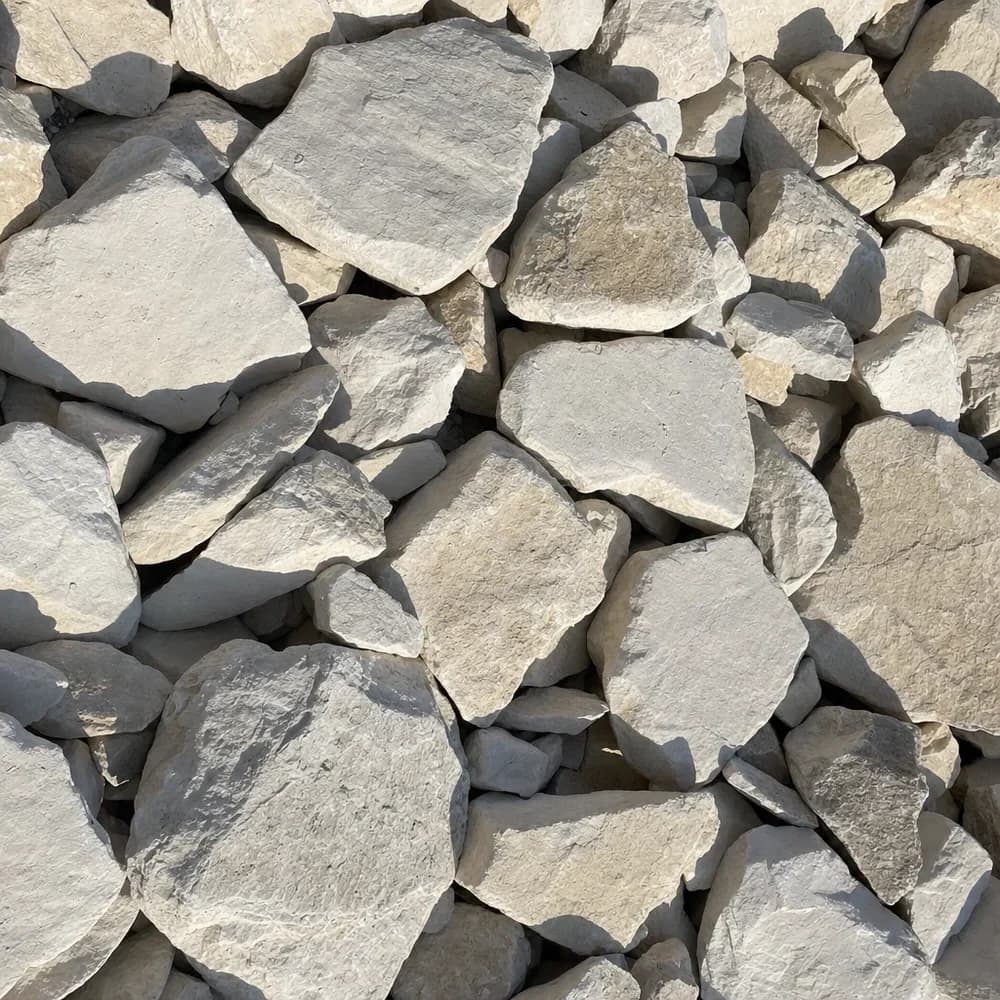
Rip Rap Calculator for Indiana Banks, Ditches and Outlets
Enter your project dimensions
Most people open this page after a storm. A ditch bank has slumped, a culvert has scoured a hole where it discharges, or the pond edge has lost a foot of soil to wave action over a wet spring. Two jobs come out of that, and they are nowhere near the same size. An apron at a downspout or culvert outlet is a few tons. Sixty feet of pond bank is a truck job several times over. Sorting out which one you have is the first thing this rip rap calculator does for you.
A Culvert Outfall and Fifty Feet of Pond Bank, Nine Times Apart
| Culvert outlet apron | Pond bank | |
|---|---|---|
| Area to armor | 6 ft by 10 ft, flat | 50 ft of shore, 7.5 ft of slope face |
| Square feet | 60 | 375 |
| Layer thickness | 12 in | 18 in |
| Cubic yards | 2.22 | 20.8 |
| Tons at 1.55 | 3.4 | 32.3 |
The apron arithmetic: 60 x 12 / 12 = 60 cubic feet, divided by 27 is 2.22 cubic yards, times 1.55 is 3.44 tons. The bank: 375 x 18 / 12 = 562.5 cubic feet, divided by 27 is 20.83 cubic yards, times 1.55 is 32.3 tons, or 33.9 with the 5% box ticked. Both are sample layouts, not customer work.
Nine times the stone for six times the area, because the bank also carries a thicker layer. Thickness is the lever on this material, far more than length.
Measuring Down the Face of a Bank, Not Across the Top of It
This is the mistake that defines the page. Every other calculator on this site takes a plan measurement, a footprint you could trace on the ground. Armor stone does not lie flat. It lies on a slope, and the slope is longer than its shadow.
- Lay the tape on the bank, from the toe at or below the waterline up to where the stone will finish. That distance is one of your two dimensions.
- The other is the length of channel, ditch or shoreline being covered.
- On a 2:1 bank 6 feet high, the face measures about 13.4 feet while the ground above it measures 12. Take the plan figure and you have under-ordered by more than a tenth before you start.
- Include the toe. The lowest course goes below the expected scour line, because undermining starts at the bottom and works up.
- Ask first. Before stone goes in below the ordinary high water line of a ditch, stream, pond or lake, find out what approval your state and local authorities require. Work in and along water is commonly permitted work, and no calculator can tell you which rules apply to your waterbody.
- On an outlet apron, run the armored length 4 to 6 pipe diameters downstream of the discharge.
Then enter it: rectangle for a straight run, circle for a plunge pool at an outfall, or multiple areas for up to five straight segments along a bank that meanders. Lengths in feet, layer thickness in inches, material selected, 5% ticked, and the result comes back in cubic yards, tons and cubic feet.
Rip Rap at 3,100 Pounds a Yard, and What Seventeen Square Feet Looks Like
Armor stone is published here at about 3,100 lb per cubic yard, or 1.55 tons, the heaviest figure on this site. Set the layer at one and a half to two times the largest stone dimension, and never under 12 inches.
| Layer thickness | 1 ton covers | Tons per 100 sq ft |
|---|---|---|
| 12 in | approx 17 sq ft | 5.7 |
| 18 in | approx 12 sq ft | 8.6 |
| 24 in | approx 9 sq ft | 11.5 |
Seventeen square feet is a patch about 4 feet by 4 feet. That is what a ton of rip rap becomes once it is spread to a working depth, and it is why a tonnage that sounds enormous covers so little bank. Landscape rock spread at 3 inches gets about 80 square feet out of the same ton, and at 2 inches well over a hundred, which is the comparison that trips people up when they price the two against each other.
Ordering Past the Toe, and the Twenty Four Inch Ceiling on the Depth Box
The depth field takes 0.25 to 24 inches. A 30 inch layer, which large stone in a fast channel can call for, will not go in as one entry. Run it as two: enter 18, note the figures, enter 12, and add them together. The same trick handles a bank where the lower half gets a heavier layer than the upper.
Order a margin beyond the calculated figure, for reasons particular to this material:
- The toe eats stone. The lowest course sits deeper than the rest and is the part you cannot come back and fix easily once water is over it.
- Nothing is flat. Stone bridges hollows in a bank rather than filling them neatly, so the face absorbs more than its measured volume.
- A thin patch is a failure point. Water finds the shallow spot, gets under the layer and takes the soil out from behind it. A short order does not leave you with a smaller armored area; it leaves you with an armored area that has a weakness in it.
Keep a few tons in reserve where the truck can reach after the first big storm, then walk the bank once the water drops and reset whatever has shifted.
What Goes Under the Armor, and Where River Rock Belongs Instead
Stone laid straight onto bare soil settles as the bank erodes out from under it. Put a non-woven geotextile down first, which comes from a landscape supplier rather than this catalogue, or 3 to 4 inches of #4 stone as a bedding layer. That bedding is a separate quantity with a different weight, about 2,900 lb per yard, so size it on the stone calculator rather than this one. On the 375 sq ft bank above, 4 inches of bedding works out at 125 cubic feet, 4.63 cubic yards, or about 6.7 tons.
Two other calls worth making before you order:
- Shape the bank to 2:1 or flatter before placing stone. A steeper face needs engineering, not more rock.
- Where the job is a hard standing or a track bed rather than a water edge, railroad ballast is the heavier coarse option.
- If the job is decorative rather than structural, a dry creek bed or a border, that is river rock and the river rock calculator sizes it at a landscape depth. Armor stone is for water that moves with force behind it.
Size class follows the water: 4 to 8 inch stone suits pond banks, downspout outfalls and slow streams, while 8 to 12 inch suits lake edges taking boat wake and faster channels. Highway and spillway work carries specified classes and layer depths on the drawing, and the drawing wins. Where the size is genuinely uncertain, go one class larger and one layer thicker.
Take the tonnage to the product page and set your quantity and date there. Delivery is arranged at checkout by ZIP code, and the truck needs firm ground with room to tip, which on a pond bank means checking the last stretch of approach before you order rather than after. Size class on an engineered job comes off the drawing, but for anything else you can talk through a bank job first.
Common questions
Does the toe below the waterline count in the area I enter?
Include the toe below the waterline and a short run of stone above the high water line, since both are part of the armored system. What you leave out is the flat ground behind it. There is no edging or border to allow for here the way there would be on a gravel bed.
Can #4 bedding and armor stone share one run of the calculator?
Two runs, two materials, two weights. Size the armor here at 1.55 tons per yard, then size 3 to 4 inches of #4 bedding stone separately at 1.45. Do not roll them into one figure, because the tonnage will come out wrong on both.
How many segments does multiple areas hold when I break up a creek bank?
Break it into straight segments, three or four of them, and measure the slope face at each. Multiple areas holds five at a time and totals them. Where the bank height changes noticeably along the run, that is a new segment, since height is the dimension that drives the volume.
The old stone has settled but still covers. What layer thickness do I enter?
Measure only the bare and thin patches, not the whole face. Where existing stone has settled but still covers, measure the depth you have against the depth you want and enter the difference as the layer thickness. Topping up an area that is already at working depth just buries good stone.
Is it better to spread a short load thin or leave the far end bare?
The gap becomes the failure point. Water works into the thin section, undermines from below and pulls soil out from behind the layer, so the armored sections either side end up doing nothing. If the load is going to be short, leave the far end of the run bare and armor it properly later rather than spreading everything thin.
Related calculators
Banks don't armor themselves.
RipRap by the ton with free delivery, plus the #4 bedding stone to go under it.