Dirt Calculator for Low Spots and Trenches on Indiana Clay
Enter your project dimensions
The window for moving fill on a till plain is narrower than the calendar suggests. Saturated clay smears under a compactor instead of packing, and a hollow that looks dry on top can still be soft a spade down, so most fill work here runs from late spring, once the ground has dried out, through fall. Measure the hole while it is still wet if that is when you notice it. Just do not order until you can stand in it without sinking.
Fill Dirt Depths for the Hollows a Wet Indiana Spring Leaves Behind
| The job | Depth to enter |
|---|---|
| Raising a low lawn area that holds water | 3 to 6 in, averaged |
| Leveling a settled depression over an old stump or trench | 4 to 8 in, averaged |
| Backfilling a tile or utility trench | the full trench depth |
| Building up a barn or shop approach before stone goes on | 6 to 12 in |
| Shaping a berm or a screening mound | 12 in and up |
| Filling behind a wall or along a foundation | the full backfill depth |
Fill is the one material here that regularly runs past the depth field, which stops at 24 inches. A berm at 30 inches is two runs, not one: enter 18, note the figure, enter 12, and add them. That splitting matches how the fill should go in anyway, since lifts of 6 to 8 inches are what compacts properly.
Averaging a Hollow That Is Deep in the Middle and Thin at the Edge
Almost nothing you fill is a neat box. Measure the length and width across the whole area in feet, then take the depth at the deepest point and the depth at the shallow edge and split the difference. That average is the number for the depth box.
- Choose rectangle, circle or multiple areas, which takes up to five pieces and totals them.
- Enter length and width in feet, or a diameter in feet for a round dip.
- Enter the average depth in inches, anywhere from 0.25 to 24.
- Choose the material.
- Leave the 10% box for compaction and spillage ticked.
- Read cubic yards, tons and cubic feet, and email the result to yourself.
A trench is easier: its length, its width and its depth are all real measurements. Use its full depth, and remember the spoil pile beside it will never go back in, because loose soil takes up more room than the ground it came out of.
Backfilling Seventy Feet of Tile Trench and Building Up a Barn Approach
These are sample layouts, not customer projects.
The tile trench. 70 ft long by 2 ft wide is 140 sq ft, at 15 in deep:
- 140 x 15 / 12 = 175 cubic feet
- 175 / 27 = 6.48 cubic yards
- 6.48 x 1.20 = 7.8 tons
- With the 10% box: 7.13 cubic yards, 8.6 tons
The barn approach. A 40 ft by 12 ft strip raised an average of 8 in is 480 sq ft:
- 480 x 8 / 12 = 320 cubic feet
- 320 / 27 = 11.85 cubic yards
- 11.85 x 1.20 = 14.2 tons
Neither figure includes what goes on top. The approach still needs a stone layer above the fill, sized on its own with the road base calculator, and the trench line needs a few inches of screened soil if grass is meant to grow over it.
A Yard of Fill Dry, and the Same Yard After Three Days of Rain
| Material | Weight per cubic yard | Tons per yard |
|---|---|---|
| Fill dirt, dry | approx 2,400 lb | 1.20 |
| Fill dirt, wet | up to 3,000 lb | 1.50 |
| Screened topsoil, for comparison | approx 2,200 lb | 1.10 |
Water adds weight without adding volume, which matters for the wheelbarrow and not for the order. You still need the same cubic yards to fill the same hole. The tool works from the dry figure, so a wet load will feel about a quarter heavier than the ton count suggests and will smear rather than compact until it dries out.
Ordering for the Settling, Not for the Hole You Measured
Loose fill drops 10 to 15% of its height as it consolidates, and on flat ground that has nowhere to shed water the first heavy rain does most of that settling for you. Three habits deal with it:
- Place it in 6 to 8 inch lifts and compact every one. Where a compactor cannot reach, soak each lift and let it settle before adding the next.
- On a lawn repair, finish about half an inch proud of the surrounding grade and let the winter bring it level.
- Keep wood, sod and root balls out of the fill. Buried organic material rots quietly and reappears as a dip years later.
Fill under a slab or a footing is a different matter, with an engineer's compaction specification and thinner lifts, so take that figure from the drawing rather than from this table.
Fill Dirt, Topsoil or Garden Soil: Three Tools, Three Jobs
This is where most of the wrong numbers start, so plainly:
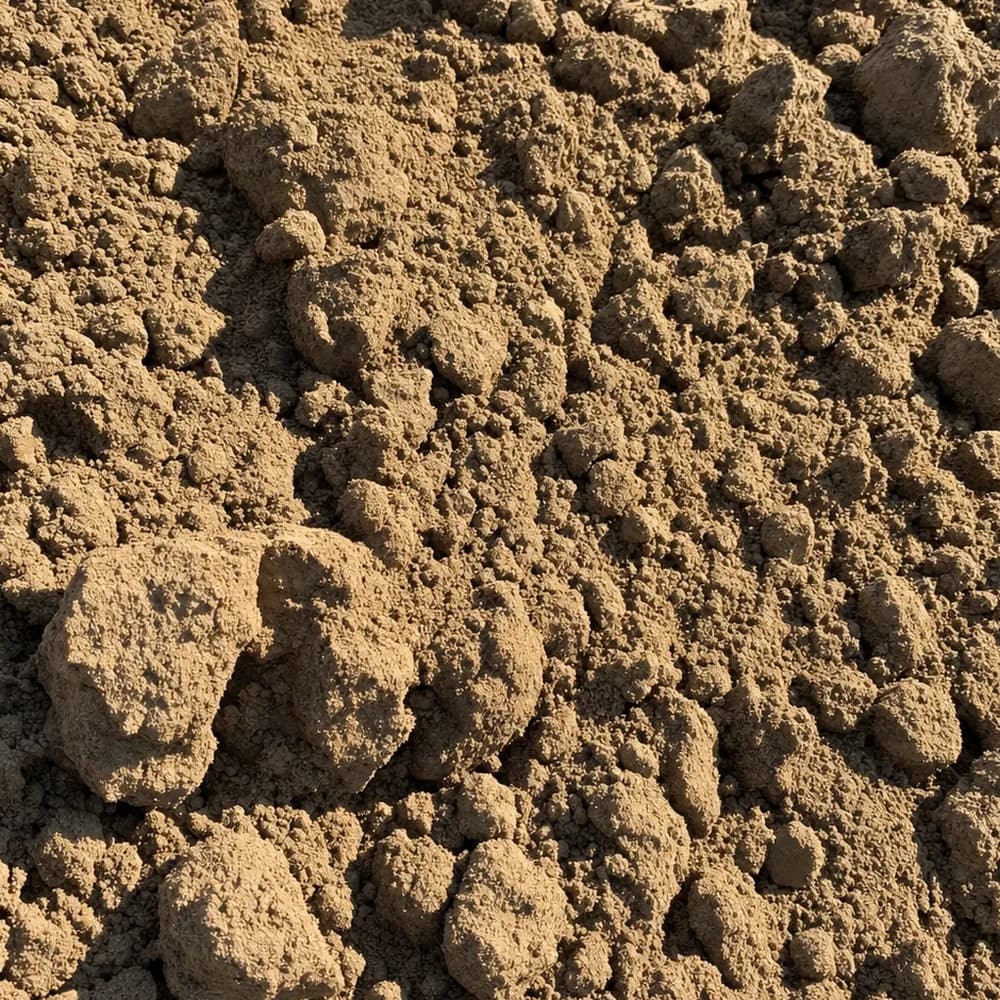
- Fill dirt is screened subsoil with little organic content, used to change grade, backfill and hold its shape. Size it here, at 1.20 tons per yard.
- Screened topsoil is the growing layer that goes 4 to 6 inches over the fill wherever grass or plants are wanted. Size it with the topsoil calculator, at 1.10 tons per yard.
- Garden soil is a blend for raised beds and planting areas and is the lightest of the three. Size it with the soil calculator.
A lawn rebuild uses two of them: fill to bring the grade up to within 4 to 6 inches of finished level, then topsoil for the rest. Run both, then set quantities and a delivery date on each product page. Delivery is arranged at checkout by ZIP code, and the truck needs a firm spot to tip on, which on soft spring ground usually means the drive rather than the yard. If the depth of a hollow is genuinely hard to call, send the measurements through the contact page before ordering.
Common questions
Yards or tons: which figure do I actually hand over when ordering?
Fill is sold here by the yard, so the cubic yard figure is the one to order on. The ton figure is there for the practical questions: how much weight is going onto the drive, and how many wheelbarrow loads stand between the pile and the hole.
Do I enter the depth of the hole, or the depth once it has settled?
The depth of the hole as you measured it, then leave the 10% box ticked and expect to add a little more later. Fill goes in loose and consolidates downward, so the ground will take slightly more than its own measured volume however carefully it is placed.
A settled dip in the lawn is roughly round. How do I size that?
Use circle mode and measure straight across the widest part for the diameter. An 8 ft dip averaging 4 in deep works out at about 50 sq ft, 16.8 cubic feet, 0.62 cubic yards, or three quarters of a ton. Anything smaller than that is a wheelbarrow job, not a delivery.
How do I check the yardage by hand before I order?
Square feet, times depth in inches, divided by 12 gives cubic feet. Divide by 27 for cubic yards. A quick sense check: one cubic yard covers 81 square feet at 4 inches, and 27 square feet at a foot deep.
Why does the same hole show different tons when I change the material?
The hole has one volume and the cubic yards prove it, coming back the same whatever you select. Weight is what separates the materials, and this site publishes fill dirt at 2,400 lb per yard against topsoil at 2,200, so the tonnage shifts while the yardage stands still.
Related calculators
Cheap by the yard, free to your gate.
Screened fill dirt for grading and backfill, delivered across Indiana.