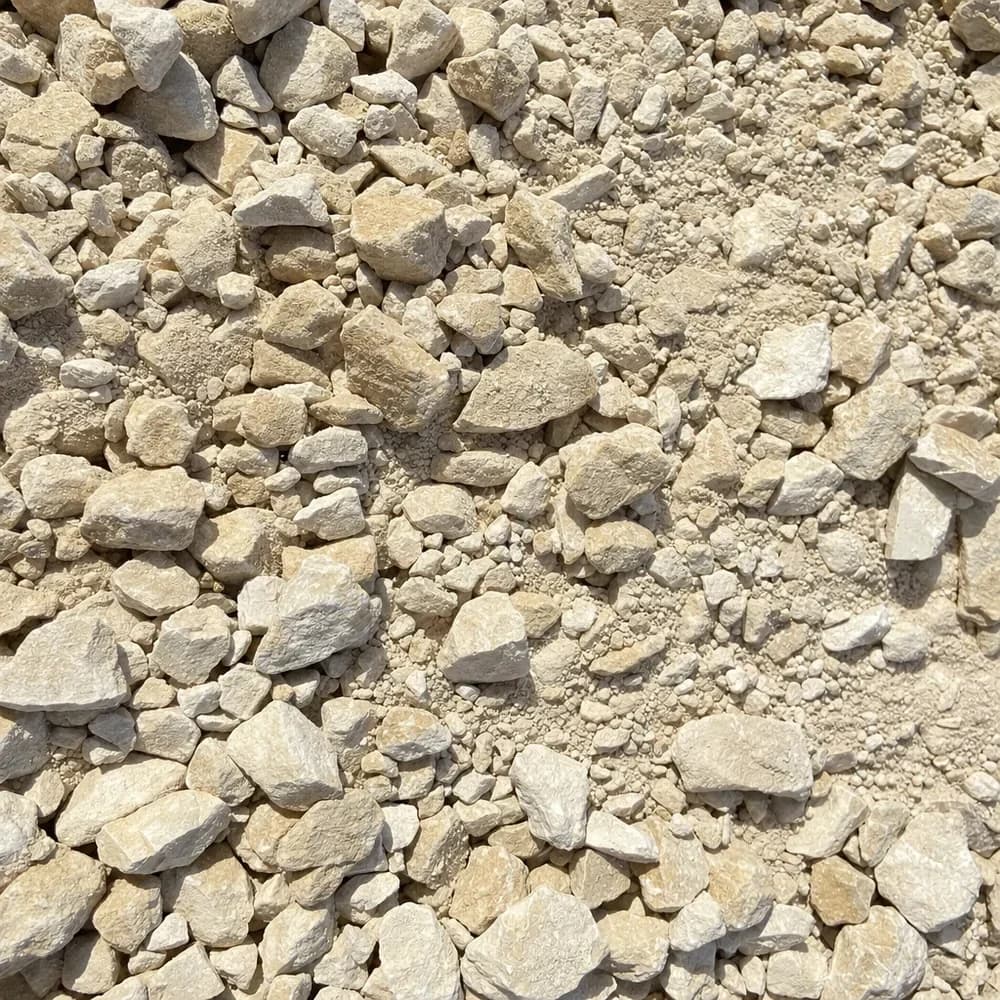
Crusher Run Calculator for Indiana Lane Tops and Shoulders
Enter your project dimensions
Walk a farm lane at the end of a wet March and the job measures itself: two wheel tracks worn into the crown, a soft shoulder where the ditch has crept inward, and a turnaround by the barn that gives up a little surface to every thaw. Those are tape measurements, not guesses. This crusher run calculator turns them into cubic yards and tons of #73 stone, the finer dense graded size, which this site publishes at roughly 3,000 lb to the cubic yard, or 1.50 tons per yard.
Getting a Tape on a Bending Lane, a Crept Shoulder and a Worn Turnaround
- A lane that bends. Wheel or pace the center line and take that as your length. Then measure the width at three or four places and average them. A tape run around the outside of a curve overstates the area every time.
- A shoulder strip. It is a long, narrow rectangle: the length of the run, by the width you actually mean to stone, not the width of the whole verge.
- A turnaround. Most are nearer a circle than a square. Measure straight across at the widest point and enter that as the diameter.
- Ruts and gate holes. Size each one separately. A rut is a rectangle. A wallowed hole at a gateway is close enough to a circle.
- Depth. Always the finished thickness you want once the stone has been rolled, never the height of the loose pile.
Round each measurement to the nearest half foot rather than rounding everything up. It is easier to add the last wheelbarrow than to store a spare half ton behind the shed all winter.
Putting a Curve Into the Shape Selector Without Losing Half the Lane
- Pick rectangle, circle or multiple areas. Multiple areas holds up to five pieces and totals them, which suits a lane split into straight runs.
- Enter lengths, widths and diameters in feet.
- Enter the depth in inches. The field accepts anything from 0.25 to 24.
- Choose the material.
- The box that adds 10% for compaction and spillage starts ticked. On anything that gets rolled or driven, leave it ticked.
- Read cubic yards, tons and cubic feet, and send the figures to yourself with the email quote button.
A lane that curves twice is three straight runs, not one long guess. Break it at the bends, enter each piece as its own rectangle, and let the tool add them.
Crusher Run Depth by Job, From a Path Base to a Grain Truck Turnaround
| The job | Compacted depth to enter |
|---|---|
| Base under pavers or a garden path | 4 in |
| Topping or resurfacing an existing lane | 2 to 3 in |
| New driveway base | 4 to 6 in |
| Where grain trucks and loaded trailers turn | 6 to 8 in |
| Shed or hot tub pad on firm ground | 4 in |
| The same pad on soft clay | 6 in |
Under pavers that table gives only the stone course; the bedding and dig depth come from the paver base calculator. Two rules go with that table on till plain ground. Place anything 4 inches or deeper in two lifts and compact each one, because a single thick layer packs only at the top. And keep this material out of a French drain or a wet hollow: the fines that make it lock up also hold water there. Clean stone belongs in drainage work, sized with the stone calculator.
If you are building the base under a new lane rather than topping an old one, #53 stone is the size Indiana specifies for it, and the road base calculator is the tool for that layer. Use this page for the finer #73: topping courses, shoulders, pad surfacing and patching. Where a looser surfacing course is wanted over a packed lane instead, that is driveway stone. Both sizes weigh the same 1.50 tons per yard, so the two tools will never disagree on weight. They differ in the depths they steer you toward.
Why a Ton of #73 Covers Less Ground Than a Ton of Clean Stone
Dense graded stone carries its own fines, and those fines fill voids that clean stone leaves open. More solid material per cube means more weight per cube.
| Material | Weight per cubic yard | Tons per yard |
|---|---|---|
| Crusher run and road base, the #73 and #53 sizes | approx 3,000 lb | 1.50 |
| Crushed stone, #57 or 3/4 inch | approx 2,800 lb | 1.40 |
At 1.50 tons a yard, one ton of #73 is about two thirds of a cubic yard. Laid at a compacted 4 inches, a cubic yard covers 81 square feet, so 100 square feet of lane at that depth takes about 1.85 tons. At 2 inches the same 100 square feet takes 0.93 tons, and at 6 inches, 2.78.
Topping 400 Feet of County Road Lane, Then Patching Four Ruts
These are sample layouts with sample dimensions, not customer work.
The lane top. A lane 400 ft long averaging 10 ft wide is 4,000 sq ft. At a compacted 2 in:
- 4,000 x 2 / 12 = 666.7 cubic feet
- 666.7 / 27 = 24.7 cubic yards
- 24.7 x 1.50 = 37.0 tons
- With the 10% box ticked: 27.2 cubic yards, 40.7 tons
The ruts. Two ruts 12 ft by 1.5 ft and two shorter ones 6 ft by 2 ft come to 60 sq ft between them. At 3 in:
- 60 x 3 / 12 = 15 cubic feet
- 15 / 27 = 0.56 cubic yards
- 0.56 x 1.50 = 0.83 tons
Under a ton for the patching, which is the useful part of running the two jobs separately. Enter the four ruts as multiple areas, note the figure, then run the lane on its own, so you know how much of the load is already spoken for before any of it is spread.
Where the Pile Should Land on a Narrow Lane
Take the tonnage to the product page, set your quantity and pick a delivery date there. Delivery is arranged at checkout by ZIP code, and the truck needs firm footing and room to tip, which on a narrow lane usually means the far end rather than the gate. Spread back toward the pile so you are not driving over finished work. If the size or the depth is still an open question, Indiana Rock Supply will talk it through from the contact page.
Common questions
The depth box: do I put in what I dump or what I end up with?
What you end up with. Dense graded stone loses roughly a tenth of its loose height under a plate compactor, so a 4 inch finished layer starts noticeably higher in the wheelbarrow. Enter 4, leave the 10% box ticked, and let the allowance cover the difference rather than padding the depth figure yourself.
How do I get a round turnaround or a fire ring apron into the tool?
Choose circle and measure straight across the widest point for the diameter, not from the middle outward. If the ring has an opening in the center that gets no stone, size the whole circle first, then the middle circle, and take the smaller figure off the larger.
Can I check the tonnage the tool gives me without re-entering everything?
Multiply your square feet by the depth in inches and divide by 12, and you have cubic feet. Divide that by 27 for cubic yards, then multiply by 1.50 for tons of #73. Working it through once on paper is also the quickest way to catch a depth typed in feet instead of inches.
Same lane, same depth, but the tons change when I switch material. Why?
Only the weight changes, never the volume. Cubic yards come back identical whatever you pick, because a cube is a cube. The tonnage moves because the site publishes a different weight per yard for each material, and the tool applies the one that belongs to your selection.
Is 10% enough on a lane that gets driven the same week?
On firm ground it usually is. Where the subgrade is soft clay that stone will press down into, or where the surface is rutted rather than flat, the real figure runs higher than any fixed percentage, so make up the difference by rounding the order to the next half ton instead.
Related calculators
Base tonnage sorted? Good.
Crusher run by the ton, the cheapest structure on the yard, delivered free.